Friday, July 16, 2010

Growing to love growing tilapia

Getting to know the intricacies of raising fish in a recirculating aquaculture system has been quite an experience thus far. We ended up with 500 Nile tilapia that are all living in one of the two 610 gallon tanks. Surprisingly, we also ended up with some hundred or so common carp in the system.

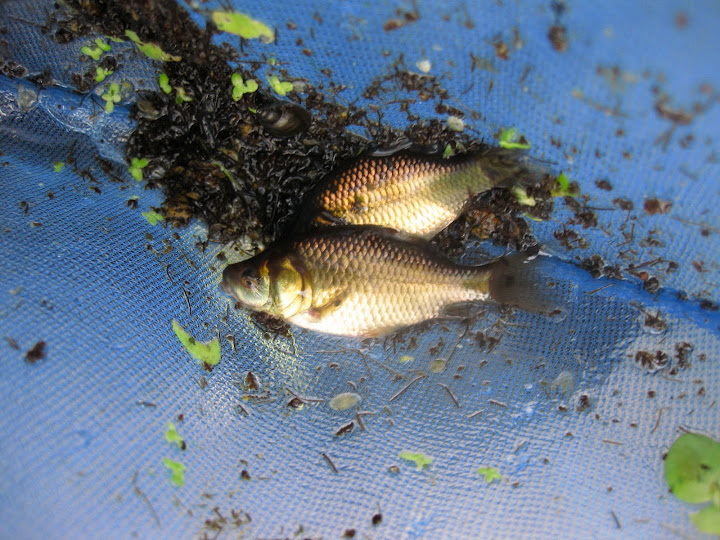
The carp (photo) weren't planned, and must have come in as eggs mixed in with some pond plants that were donated to us from a local pond. While carp are a huge pest that outcompetes other wild fish, they are no match for the voracious appetite and frenzied feeding of the tilapa.

As long as we keep all these potentially invasive species locked up in our system until they make their way to the freezer or smoker, then all should be well.

If you've read my previous posts, you'll notice that this one is a pretty big jump ahead in the timeline of our startup. From the time the fish came to now has been a whirlwind couple of months (this is just one of many projects i'm involved in). A short recap is in order:

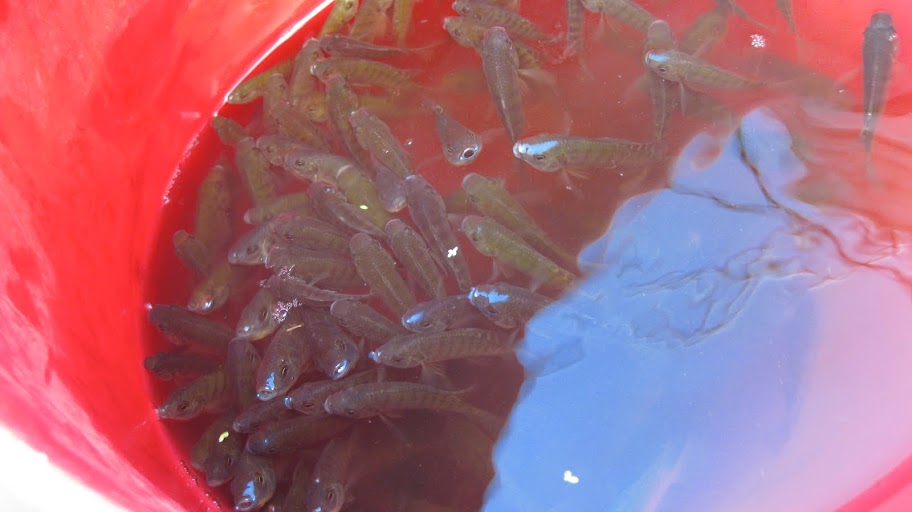
The fish came as 0.15 oz fingerlings on May 28th (my birthday). They were immediately put into the indoor fry tanks. After a feeding mix up on the second day, one of the tanks was fouled with too much food, and all of the fish were moved into one tank. Yes, that is 500 fish in 100 gallons.

It seemed like the home-made biofilter was working fine at that stocking density for a while. As the fish grew to around 0.25 oz and the feeding increased the total ammonia levels were rising to around 4 ppm each night, and returning to 0.2 by the morning. This was just within tolerable limits, as long as the PH stays low (see un-ionized ammonia for details).

Just to be safe, and to remove the continued buildup of nitrates, we did a 20% water change once per week. That involved a small trick of bringing the PH of our tap water down from 9.2 to 7.2 using a PH buffer chemical.

The fish grew to love me as the hand that feeds them. Every time i walked by the tank they would start churning at the surface, and at feeding times they devoured all of the food that i gave them. At that stage they were getting a fingerling food (from our project partners at Jim's Online Fish Shop) at 4% of their body weight per day. That worked out to approximately 1/4 cup food, three times / day.
THE BIG MOVE

On June 10th we moved all of the fish down to the main tanks, which were now swinging between 74 - 84 deg. F. Carried down in three buckets, we floated the buckets in the tanks while slowly topping them off with tank water to stabilize the temp and PH. Once the water had equalized, we gave all of the fish a 3 minute salt dip (3% solution) to minimize the risk of parasites (which come off in the salt water).

The fish were then set free, and I haven't seen them since. I'm down there every day to feed them and maintain the system, but they are very hard to see as brownish fish in the green water, in a blue tank.
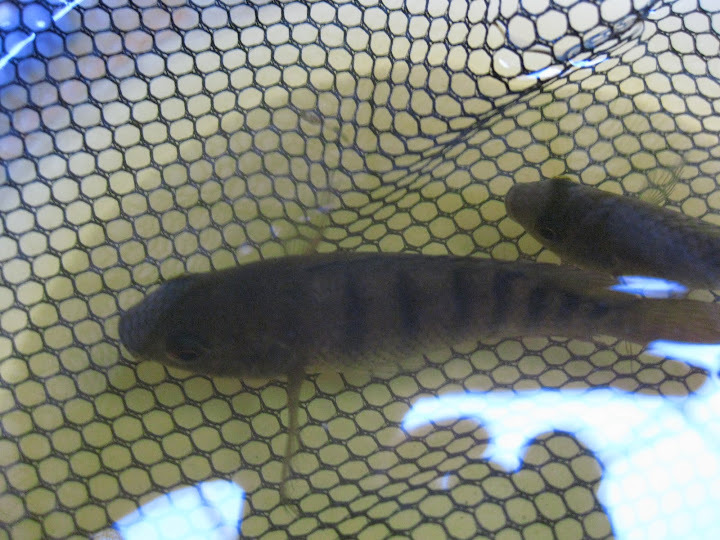
I did manage to catch a few yesterday (which involved a very quick net that caused at least 20 fish to jump straight up out of the water and away from my net). They look healthy and are weighing in at an average of 0.85 oz. (the fish pictured here is 3.5" long). We're upping their total feed to 1 pound / day, and have been successfully supplementing approx. 25% of that with duckweed that is growing in the filter trays.

There's lots of interesting plants growing in the system now, but I'll talk more about those in my next post (hopefully sooner than later).

For more pictures go to: http://picasaweb.google.com/aprovecho.mail/Aquaculture2010#


Monday, April 26, 2010

It's Alive (and green)!


The acclimation of both the main tanks and the fry tanks is going well.
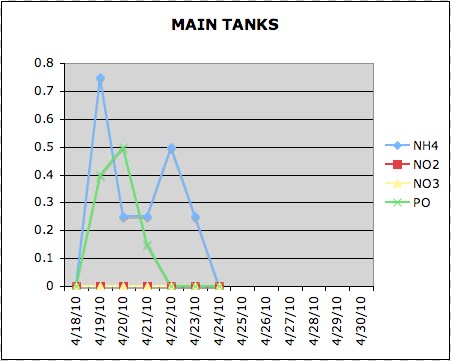
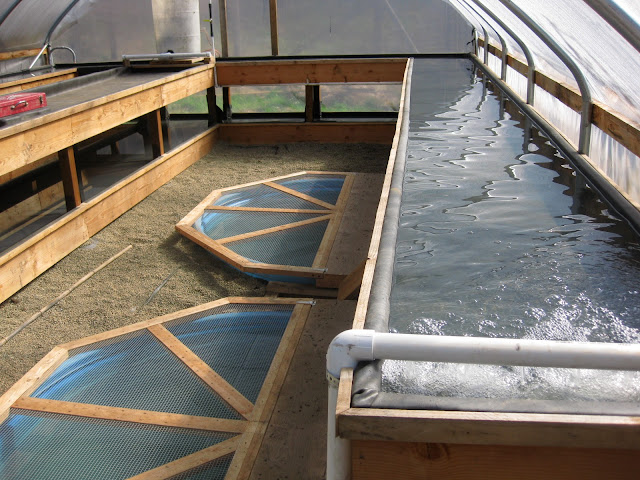
We added approx 5 lbs of fresh chicken manure to the main tanks (in a mesh bag) which brought the ammonia and phosphate levels up from 0 (see chart). After two days everything turned green. The plants, the water, and every surface in the system.

Algae can be both a friend and an enemy in a recirculating system like this. The tilapia are adapted to feeding on it, and it removes phosphates and toxic ammonia from the system. It actually produces oxygen when it is growing (during photosynthesis). During the night and on cloudy days, it can consume more oxygen that it produces and if a die-off occurs, it can tie up huge amounts of oxygen and produce toxic ammonia. That could equate to lots of dead fish.

We're going to try to avoid that later by providing supplemental oxygenation to the fish through a blower pump and air stones. I've just ordered a dissolved oxygen meter, so we will be able to report on what is really going on in the water. If you know the dissolved O2, the PH, temperature, and total ammonia, you can figure out how much toxic ammonia (unionized) is in the system.

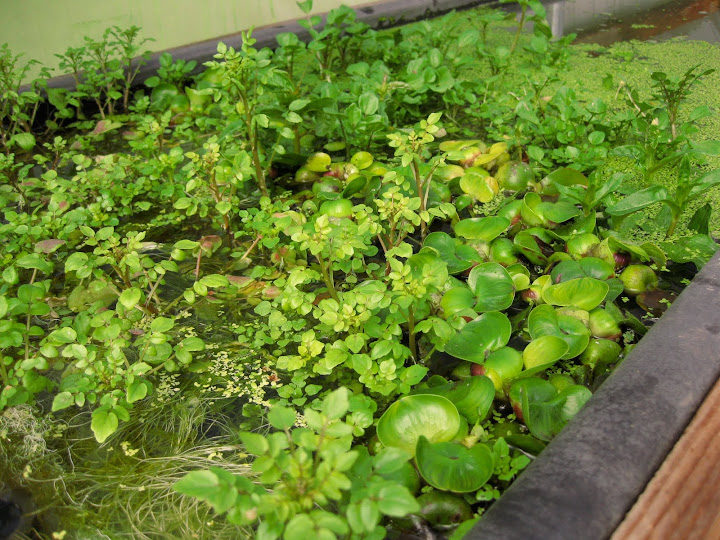
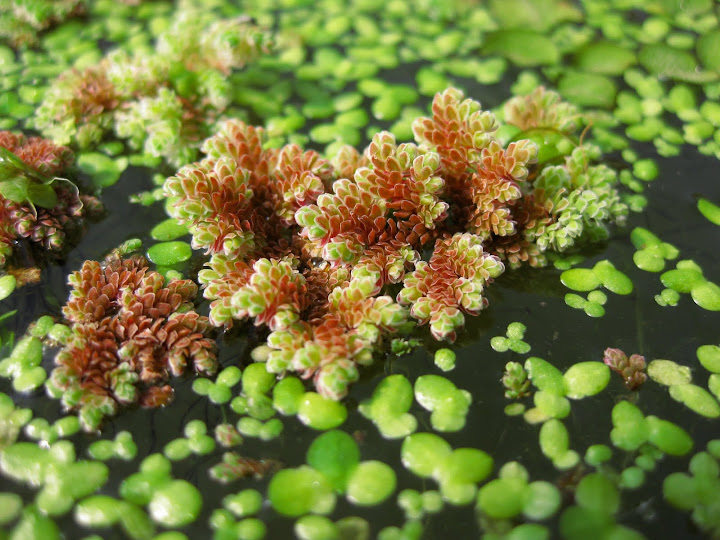
Anyways, i have digressed. We were lucky to have been given access to a local pond for plant harvesting. We brought back a generous helping of azolla, also known as red water fern. It forms a dense floating mat, and will supplement the tilapia feed. It pretty much covers the entire bottom trays now.

We've also got a healthy population of duckweed, water hyacinth, frogbit, salvinia, watercress, and water hawthorn. We're figuring out the feasability of growing water chestnut, wasabi, ginger, and tumeric as well.


We're expecting the fish in 1-2 weeks and still plan on starting them out in the indoor fry tanks. The water temps in the main tanks (greenhouse) are swinging approx 10 degrees F from day to night. Best temps we've seen so far (after 4 straight days of sun) were 67 - 77. Ideal would be ranging from 82 - 92.

Lastly, we're fortunate to have a new partner in this endeavor. Jim and Reta Knott with Aquafarms fish food are providing us with fish chow that doesn't contain any land animal product. We'll be starting them out on this feed, as they require more fat as juveniles, then transitioning them over to a mostly vegetarian diet as they get older.

That's all for now. Next post should be all about the arrival of fish. Very exciting.

More photos here


Wednesday, March 31, 2010

Fish Fry (that's a baby fish, not a taco filling... yet)

The fish are due to arrive in 3 weeks. 1500 baby tilapia fry. They will weigh approx 1/2 gram each and be about 1 inch long. The biggest challenge to raising Tilapia in the Pacific Northwest will be maintaining warm water temps (ideally 70 - 85 F). The average water temp in the main tanks this week has been 55 F. That's pretty much a lethal temp for Tilapia.

Our plan is to initially raise the young fry indoors (in the strawbale dorm). We
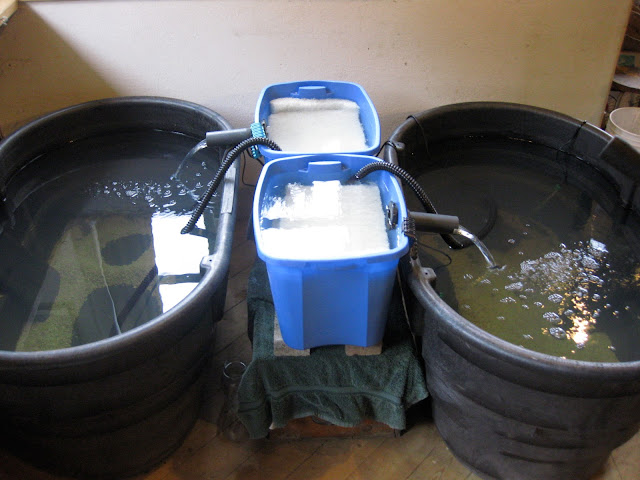
've set up two 100 gallon
feed tanks to start them off. There is a submersible pump in each tank (approx $30 each) which pumps the water into a plastic bin full of filter media. Basically filter media can be anything with lots of surface area for bacteria to grow on. Besides the physical aspect of the filter keeping solids from going back into the tanks, you want a colonization of bacteria to deal with the removal of ammonia through a nitrification process.

The water gravity flows back into each tank. If the pu
mp stops working, the water stops flowing back. It's really important to fool proof your design. I try to remember that "what can go wrong, will go wrong
". I would hate to wake up to having all of the fish dead in two inches of water, or the tank overflowing and the fish dead on the floor. Both possible if the system pumping and returns are set up differently.

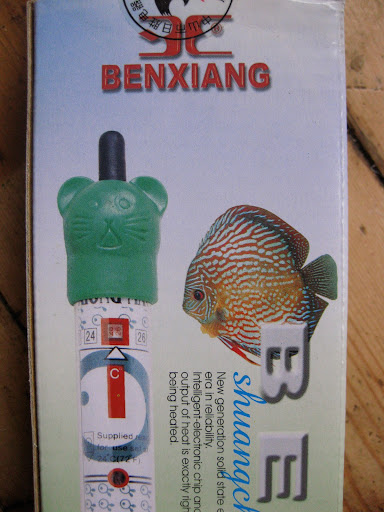
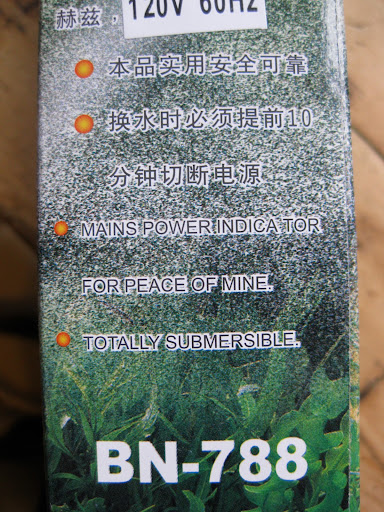
Right now we have two 300 watt aquarium heaters in each tank to keep the temp around 75 F. I go them on Ebay, made in China. Check out the photos. I especially like the plastic molded cat head on their tops. Not to mention the humorous translations on the box. I'm going to experiment this week with using timers and different settings on the heaters to mimic the daily fluctuation in temp that will be part of their lives in the main tanks. I figure that might be a good way to "harden them off" before they move to their permanent home in the greenhouse.

That's all for now. More to come.

Monday, March 29, 2010

Background


I'm starting this blog for anyone who's interested to follow the progress of Aprovecho's newest area of inquiry, experimentation, and research. Aquaculture and Aquaponics. If you don't know what it is, they have this thing on the internet called "google" It can explain it much better than I.

Suffice it to say that we built a recirculating aquaculture system in a 20'x30' greenhouse here. I will attempt to keep this space updated with photos, videos, and information on how things are going with our system. More details coming soon.... Stay tuned.